
In the early days of cinema, the “talkies” revolutionized the medium by giving stars a voice. Today, a new revolution is underway—one where the voice isn’t just an accessory to the performance, but the performance itself. The modern film landscape, dominated by high-end animation, performance capture, and immersive sound design, has elevated the voice actor from a hidden contributor to a cornerstone of the production process.
As we look at the industry in early 2025, the distinction between “screen actors” and “voice actors” is blurring. Major studios now recognize that the vocal cords are as vital a tool as any physical gesture, and the technical precision required to bring a character to life without being seen is a specialized craft that dictates a film’s emotional resonance.
The Evolution of the “Vocal Performance”
Historically, voice acting was often relegated to Saturday morning cartoons or dubbing foreign films. However, the paradigm shifted with the advent of the “celebrity voice” era, famously ignited by Robin Williams in Aladdin. While that era leaned heavily on star power, the modern era prioritizes vocal versatility and emotional depth.
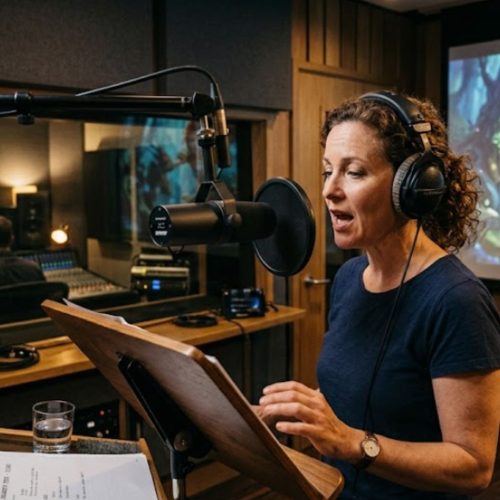
In contemporary production, a voice actor’s job begins long before the final animation is rendered. Unlike traditional acting, where the environment and costume help ground the performer, voice actors must build an entire world within the four walls of a sound-deadened booth. They provide the “soul” of the character that animators then use as a blueprint. Every sigh, stutter, and micro-inflection serves as a guide for the visual artists to sync the character’s facial movements and body language.
Performance Capture: The Convergence of Physicality and Sound
One of the most significant shifts in the industry is the rise of Performance Capture (P-Cap). High-budget franchises now utilize technology that records an actor’s physical movements and vocal performance simultaneously. In these scenarios, the actor is essentially performing a one-man play in a gray spandex suit covered in markers.
This technology has turned voice acting into a full-body athletic endeavor. Actors like Andy Serkis or Benedict Cumberbatch have demonstrated that the “voice” is intrinsically tied to the “move.” According to industry insights from The Hollywood Reporter, the integration of performance capture has led to a push for these performers to be recognized in mainstream awards categories, arguing that their contributions are no less significant than those of actors in traditional costume.
The Technical Mastery of the Booth
Beyond the creative performance, modern voice acting requires a high level of technical proficiency. A voice actor must understand mic technique—knowing how to manipulate their distance from the microphone to create intimacy or project power without “clipping” the audio.
- ADR (Automated Dialogue Replacement): Often called “looping,” this is where actors re-record lines from a live-action shoot to improve audio quality or change a performance note. This requires the actor to perfectly match the lip-flaps of their filmed self, often months after the original scene was shot.
- Walla and Group Loops: These actors create the “atmosphere” of a film. Whether it’s the hushed whispers of a crowded gala or the guttural roars of an alien army, these specialized performers layer the soundscape to make the world feel lived-in.
- Vocal Stress Management: Modern action films or video-game-to-film adaptations often require hours of screaming, grunting, or “death rattles.” Professionals must use specific techniques to avoid permanent vocal fold damage, a skill that is now a mandatory part of a high-level voice actor’s toolkit.
AI and the Ethical Frontier
As of 2025, the elephant in the recording booth is Artificial Intelligence. Generative AI can now clone voices with startling accuracy, leading to a heated debate regarding “vocal rights” and the “human element.”
The industry is currently grappling with how to protect the unique timbre and “acting” of a human performer. While AI can replicate a tone, it struggle to replicate the intentionality of a human performance—the ability to take a director’s abstract note (“make it sound like you’re hiding a secret, but you’re happy about it”) and translate that into a nuanced vocal take. Organizations like SAG-AFTRA have been at the forefront of negotiating protections for performers, ensuring that “digital twins” do not replace the sentient creativity that defines great cinema.
The Global Impact: Localization vs. Dubbing
The role of the voice actor is also pivotal in the global distribution of film. In a world where streaming services make a South Korean thriller or a Spanish drama available globally in seconds, localization has become a multi-billion dollar sub-sector.
Modern dubbing is no longer about simply translating words; it’s about cultural translation. A voice actor dubbing a lead role must match the original actor’s cadence and emotional beats while making the dialogue feel natural to a local audience. This “invisible” work is often what determines whether a foreign-language film succeeds in international markets.
Conclusion: The Unseen Architect of Emotion
The voice actor is the unseen architect of modern cinema’s most memorable moments. Whether they are breathing life into a CGI dragon, providing the internal monologue for a protagonist, or redubbing a line to save a muddy live-action take, their influence is everywhere.
As technology continues to evolve, the demand for high-quality vocal performances will only grow. In an era of visual saturation, the human voice remains the most direct line to an audience’s empathy. The “actor in the booth” is no longer just a supporting player; they are a primary engine of the industry’s creative and commercial success.…