Category Archive

Dubbing Industry

The Global Voice: How Dubbing Powers International Cinema


Posted on May 20, 2025 by George
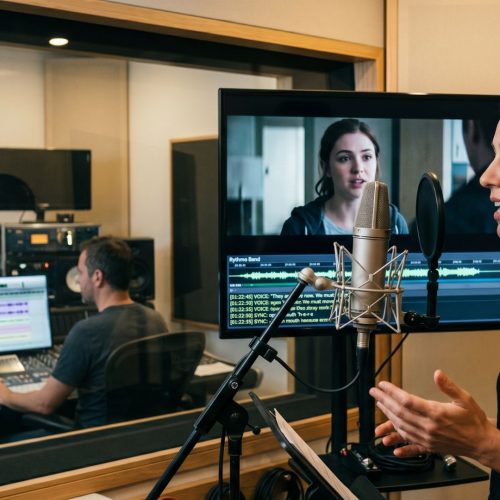
The magic of cinema has always been its ability to transcend borders, but while a stunning visual needs no translation, dialogue is a different beast entirely. To bring a blockbuster from Hollywood to the streets of Seoul, or a gritty Spanish thriller to an audience in Chicago, filmmakers rely on the intricate, often invisible art of dubbing.

Far more than just replacing one language with another, dubbing—formally known as Automated Dialogue Replacement (ADR) or language localization—is a sophisticated blend of technical precision, linguistic adaptation, and raw acting. It is the reason a foreign film can feel like a local masterpiece.


1. The Script Adaptation: Finding the “Lip-Sync”

The process begins long before an actor enters a recording booth. A direct translation is rarely enough. If an English character says “Hello,” it takes a fraction of a second. The Spanish equivalent, “Hola,” matches well, but the German “Guten Tag” is significantly longer.

Translators and “adapters” work together to ensure the new dialogue matches the labial movements (lip-sync) of the original actors. This involves:

  • Phonetic matching: Prioritizing words that start with similar consonants (like ‘P’, ‘B’, or ‘M’) which require the lips to close.
  • Length management: Ensuring the sentence ends exactly when the actor on screen stops talking.
  • Cultural Nuance: Swapping local idioms for equivalents that preserve the original intent without confusing the new audience.

2. The Casting Call for Voices

Dubbing is often called “acting in the shadows.” Studios don’t just look for voices that sound like the original; they look for voices that capture the emotional essence of the performance.

In many countries, such as Italy, France, and Germany, certain “voice doubles” become the permanent local persona for Hollywood stars. If you watch a Tom Hanks movie in Italy, chances are you are hearing the same Italian actor who has voiced him for decades. This creates a sense of continuity and trust with the audience.


3. The Technical Process: Inside the Booth

Once the script is “locked” and the talent is cast, the technical phase begins. This is where the marriage of art and engineering happens.

The Rhythm of the “Beep”

Actors usually record in a darkened studio, watching the original footage on a monitor. To help them time their lines, they use a system of visual or audio cues. A common method is the “three-beep” system: the actor hears three rhythmic tones and must begin their line exactly where the fourth “silent” beat would land.

Layering the Sound

In modern cinema, the original audio isn’t just one file; it’s a complex “M&E” track (Music and Effects). According to the technical standards highlighted by the Society of Motion Picture and Television Engineers (SMPTE), maintaining the integrity of the background ambiance while replacing the center-channel dialogue is crucial.

The dubbing engineers must ensure that the new voices don’t sound “flat” or like they were recorded in a sterile room. They use reverb and equalization to make the voice match the environment on screen—whether it’s a cavernous cathedral or a cramped car.


4. Cultural Localization vs. Translation

A major challenge in international cinema is how to handle humor and slang. A joke about American baseball might fall completely flat in Japan. In these instances, the dubbing director makes a “creative pivot.”

For example, when Disney localizes its films, they often rewrite entire songs or jokes to resonate with local folklore. This level of detail is what allows a film to feel “native” to its new territory. It is a testament to the global reach of the industry, a topic often explored in-depth by The Hollywood Reporter when analyzing international box office trends.


5. The Evolution: AI and the Future of Dubbing

We are currently entering a transformative era for international cinema. Traditional dubbing is expensive and time-consuming, often taking weeks or months for a single feature film.

Artificial Intelligence is now beginning to play a role through:

  • Voice Cloning: Using AI to replicate the original actor’s voice in a different language, maintaining their specific timbre and grit.
  • Neural Lip-Syncing: Using deepfake-style technology to actually alter the mouth movements of the actor on screen to match the new language’s phonemes.

While some purists argue this removes the “soul” of the voice actor’s performance, others see it as a way to democratize global content, allowing smaller indie films to reach worldwide audiences without the massive overhead of traditional dubbing houses.


6. Why Dubbing Prevails Over Subtitles

The debate between “Sub vs. Dub” is eternal. While subtitles preserve the original performance, dubbing offers a more immersive experience for many.

  • Visual Continuity: Dubbing allows the viewer to focus on the cinematography and the actors’ eyes rather than reading text at the bottom of the screen.
  • Accessibility: For children’s films or for audiences with visual impairments or lower literacy rates, dubbing is the only viable gateway to international stories.
  • Emotional Impact: Hearing a character scream or whisper in one’s native tongue often carries a more visceral emotional weight.

Conclusion

Dubbing is a high-wire act of synchronization. It requires the translator’s wit, the actor’s passion, and the engineer’s precision. When done poorly, it can be a distraction; but when done well, it is invisible. It allows a story told in a small village in South Korea to break hearts in a cinema in Paris, proving that while our languages are different, the emotions we convey through film are universal.

As technology continues to bridge the gap, the “international” label on cinema may eventually disappear, leaving us with just one thing: great stories, heard by everyone.…


0
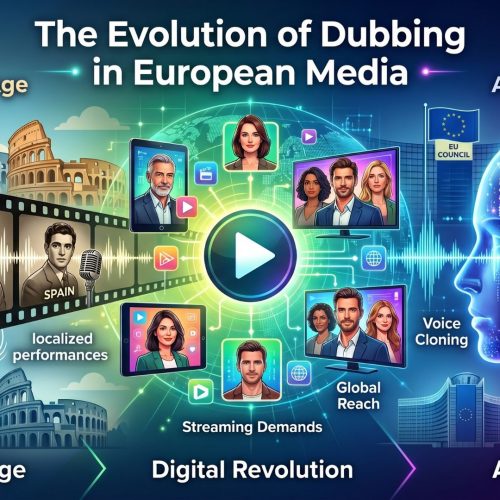
The Evolution of Dubbing in European Media: A Linguistic and Cultural Journey


Posted on November 28, 2024 by George

The landscape of European cinema and television is a polyglot tapestry, woven together by a complex history of translation. While subtitling has its staunch defenders, it is the art of dubbing—the process of replacing the original vocal track with a localized version—that has fundamentally shaped the media consumption habits of millions across the continent. From the early experiments of the “talkies” to the sophisticated AI-driven workflows of 2024, the evolution of dubbing in Europe is a story of national identity, political influence, and technological triumph.


The Birth of the “Talkies” and the Language Barrier

In the silent film era, cinema was truly universal. Intertitles could be easily swapped out for different languages, allowing a film produced in Berlin to be understood in Paris or Rome with minimal effort. However, the advent of synchronized sound in the late 1920s created a sudden, formidable barrier.

Initially, studios attempted Multiple-Language Versions (MLVs). This involved filming the same scene several times with different casts speaking different languages. It was an expensive, logistical nightmare. The industry needed a more efficient solution, leading to the birth of rhythmic phonetics and synchronization. By the early 1930s, the “Dubbing vs. Subtitling” divide began to take root in Europe, largely dictated by the size of the domestic market and the prevailing political climate.

The “Big Four”: Dubbing as a Tool for Sovereignty

Europe famously split into two camps: the “subtitling countries” (such as the Netherlands, Scandinavia, and Portugal) and the “dubbing countries” (France, Italy, Germany, and Spain). For the latter group—often referred to as the Big Four—dubbing was more than a convenience; it was a tool for linguistic protectionism and national prestige.

  • Italy: Under Mussolini, the Italian government banned the screening of films in foreign languages to promote a unified Italian identity. This birthed an elite class of voice actors who became celebrities in their own right.
  • Spain: Similarly, the Franco regime utilized dubbing as a means of censorship, allowing the state to rewrite dialogue that was deemed politically or morally subversive.
  • France: The French have long viewed dubbing as a way to defend the Francophonie against the “linguistic imperialism” of Hollywood.
  • Germany: With a massive domestic audience, Germany developed a highly industrialized dubbing sector that prioritized high-fidelity acoustic reproduction.

As noted in recent industry analyses by The Hollywood Reporter, these historical foundations created a deep-seated cultural preference where audiences in these regions often find subtitles distracting, preferring the immersive, “invisible” experience of a well-executed dub.


The Golden Age of Synchronization

By the mid-20th century, dubbing had evolved into a sophisticated craft. It wasn’t just about translating words; it was about lip-syncing—matching the labial movements of the onscreen actor—and isochrony, ensuring the dubbed line lasted exactly as long as the original.

This era saw the rise of the “exclusive voice.” In many European countries, a specific local actor would become the “official” voice of a Hollywood star. For decades, a German viewer wouldn’t recognize Bruce Willis without the distinct gravelly tones of Manfred Lehmann. This created a unique psychological bond between the audience and the foreign media, making international stars feel like local icons.


Digital Transformation and the Streaming Revolution

The transition from analog tape to digital workstations in the 1990s and 2000s revolutionized the speed and quality of localization. However, the most significant shift came with the rise of global streaming giants like Netflix, Disney+, and Amazon Prime.

Suddenly, the demand for high-quality European content (and the export of American content into Europe) skyrocketed. This “Globalized Era” forced a change in how dubbing was perceived. It was no longer just about the Big Four. Markets that traditionally preferred subtitles began to embrace dubbing for high-budget “event” series to increase accessibility for multi-tasking audiences.

Furthermore, the technical standards became more rigorous. Modern dubbing studios now utilize Dolby Atmos technology to ensure that the localized dialogue sits perfectly within the original soundscape, maintaining the director’s intended spatial audio experience. This level of immersion has narrowed the “quality gap” that once made dubbed versions feel like inferior copies of the original.


The 2024 Frontier: AI and Neural Dubbing

As of late 2024, the industry is navigating its most disruptive period yet: the integration of Artificial Intelligence. The evolution has moved from manual translation to AI-assisted scripts and, controversially, synthetic voice cloning.

Modern developments include:

  1. Automated Dialogue Replacement (ADR) Enhancement: AI tools can now subtly alter the mouth movements of the original actor to match the phonemes of the dubbed language, a process known as “Visual Dubbing.”
  2. Voice Preservation: AI allows the original actor’s unique timbre and emotional inflection to be mapped onto the foreign language performance, ensuring that “Tom Cruise” sounds like “Tom Cruise,” regardless of the language he is speaking.
  3. Localization Speed: What used to take months can now be achieved in weeks, allowing for near-simultaneous global releases.

Despite these advancements, the European dubbing community remains a bastion of human artistry. Labor unions in France and Italy have been vocal about protecting the “soul” of the performance, arguing that while AI can mimic a voice, it cannot yet replicate the cultural nuance and comedic timing of a seasoned human actor.


Cultural Impact: A Unified European Screen?

The evolution of dubbing has done more than just move films across borders; it has fostered a shared European pop culture. Through dubbing, a Spanish series like La Casa de Papel (Money Heist) became a household name in Germany and Poland. It has bridged the gap between the continent’s diverse linguistic groups, allowing stories to travel freely while respecting the local language of the viewer.

Summary Table: Evolution of Dubbing Techniques

EraPrimary MethodGoal
1930s-1950sEarly Optical SoundBasic linguistic comprehension / State censorship.
1960s-1980sMagnetic Tape / ADRPerfecting lip-sync and “exclusive” star voices.
1990s-2010sDigital WorkstationsHigher acoustic fidelity and faster turnaround.
2020-PresentAI & Neural DubbingVisual sync (Deepfake) and original voice cloning.

Conclusion

From its origins as a crude necessity of the early sound era to its current status as a multi-billion euro high-tech industry, dubbing has remained the invisible engine of European media. It is a testament to the continent’s desire to remain connected without sacrificing its linguistic heritage. As we move further into the decade, the blend of human performance and technological precision will likely make the “language barrier” a thing of the past, ensuring that a story told in one corner of Europe can resonate deeply in every other.…


0