Category Archive

Film & Media

Why Localization Matters in Global Streaming Platforms


Posted on August 14, 2025 by George

In the current era of digital borderlessness, the phrase “content is king” has undergone a necessary evolution. For global streaming giants, content is only king if the audience can actually understand, relate to, and immerse themselves in it. As platforms like Netflix, Disney+, and Amazon Prime Video expand into every corner of the globe, the focus has shifted from mere distribution to deep localization.

Localization is no longer just a “hot topic”—it is the primary engine of growth in a saturated market. It is the difference between a platform being a foreign visitor in a local market and becoming a household staple.


Beyond the Subtitle: Defining Modern Localization

To the casual viewer, localization might seem like a simple choice between subtitles or dubbing. However, for a streaming service aiming for global dominance, the process is far more surgical. It involves adapting a product’s linguistic, cultural, and technical elements to meet the specific needs of a target market.

This includes:

  • Cultural Nuance: Adjusting humor, idioms, and social references that don’t translate literally.
  • User Interface (UI) Adaptation: Ensuring the app layout handles different character sets (like Arabic or Kanji) and reading directions.
  • Local Original Content: Producing shows within a country, using local talent and stories, rather than just exporting Hollywood hits.

As noted by industry analysts at Variety, the shift toward local-language originals has fundamentally altered the competitive landscape, forcing US-based streamers to think like local broadcasters in every territory they enter.


The “Squid Game” Effect: Breaking the Language Barrier

Perhaps the most significant turning point for localization was the meteoric rise of the South Korean series Squid Game. Its success proved a vital hypothesis: global audiences are willing to consume non-English content if the emotional beats are universal and the localization is high-quality.

When a platform invests in high-end dubbing—using voice actors who capture the emotional grit of the original performance—the “barrier” of language disappears. This has led to a “glocalization” strategy: creating content for a specific local market that possesses the high production value and universal themes required to travel globally.

Cultural Relevance as a Retention Tool

In the streaming wars, customer acquisition is expensive, but “churn” (users canceling their subscriptions) is the silent killer. Localization is a powerful tool for retention. When a user in Brazil or India opens their streaming app and sees a curated homepage featuring local holidays, regional dialects, and familiar faces, they feel a sense of ownership over the platform.

If a platform feels “too American” or “too Western,” it remains a luxury add-on. But when it invests in local storytelling, it becomes an essential part of the cultural conversation. This is why we see streaming services investing billions into production hubs in Madrid, Seoul, and Mumbai. They aren’t just translating stories; they are building local creative ecosystems.


The Technical Challenges of Going Global

Localization is as much a feat of engineering as it is of linguistics. One of the most overlooked aspects is Metadata Localization. For a search algorithm to work effectively in a foreign country, the tags, descriptions, and titles must be optimized for how local users actually type and speak.

Furthermore, technical infrastructure must account for local realities. In many emerging markets, high-speed fiber isn’t a guarantee. Effective localization includes “lite” versions of apps that function on lower-end devices or offer robust offline viewing options—a necessity in regions where data costs are high and connectivity is intermittent.

According to insights from The Hollywood Reporter, the infrastructure behind global delivery—ranging from cloud-based dubbing workflows to AI-assisted subtitling—is now just as important as the A-list talent appearing on screen.


The Role of AI in Scaling Localization

As of 2025, Artificial Intelligence has become the “secret sauce” for scaling these efforts. While human translators are essential for creative nuances and “cultural “vibe checks,” AI helps manage the sheer volume of content.

  • AI Dubbing: New technologies allow for “voice cloning” where the original actor’s voice can be synthetically recreated in another language, maintaining the same timbre and emotional inflection.
  • Lip-Sync Tech: Generative AI is being used to subtly alter the mouth movements of actors on screen to match the phonemes of the dubbed language, reducing the “uncanny valley” effect that often distracts viewers of dubbed content.

However, the industry remains cautious. The goal is to use AI to handle the “heavy lifting” of literal translation while leaving the artistic soul of the dialogue to human writers who understand the slang of a Tokyo street or the sarcasm of a Parisian café.


The Economic Imperative

The math is simple: the North American market is reaching a point of “peak streaming.” For a company to show growth to its shareholders, it must look to the “Next Billion” users in Southeast Asia, Africa, and Latin America.

These users are not interested in a one-size-fits-all catalog. They want to see their lives reflected on screen. Localization, therefore, isn’t just a polite gesture of inclusivity; it is a hard-nosed economic necessity. Platforms that fail to localize properly find themselves relegated to a niche status, while those that embrace local cultures find themselves at the top of the charts.

Conclusion: The Future is Hyper-Local

The future of global streaming is paradoxically local. We are moving toward a world where a teenager in Lagos, a retiree in Berlin, and a student in New York can all watch the same show on the day of release, each experiencing it in a way that feels native to them.

Localization has matured from a post-production afterthought into a core pillar of development. By respecting the nuances of language and the depth of cultural identity, global streaming platforms are doing more than just selling subscriptions—they are facilitating a global cultural exchange that was once unimaginable. In 2025 and beyond, the streamers that win won’t be the ones with the loudest voices, but the ones that speak the most languages fluently.…


0
The Invisible Art: Voice Performance in Animation vs. Live-Action


Posted on January 6, 2025 by George

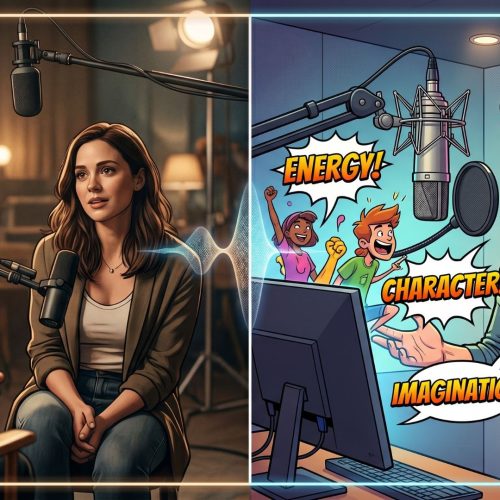
In the realm of modern storytelling, the human voice remains the most potent tool for emotional transmission. However, the technical and creative demands placed on a performer vary wildly depending on whether they are appearing on camera or behind a microphone. While both mediums require a deep understanding of character and subtext, the transition between live-action and animation is far from a simple change of wardrobe. It is a fundamental shift in how a performance is constructed, captured, and delivered to the audience.

The Physicality of the Frame

In live-action performance, an actor has a vast toolkit of non-verbal communication. A slight twitch of the eye, the slump of a shoulder, or a heavy sigh caught in a close-up can communicate volumes without a single word being spoken. The actor’s body is their primary instrument, and the voice is often just one component of a holistic physical presence.

Conversely, voice actors in animation work within a sensory vacuum. Because the audience cannot see the performer, every ounce of characterization must be poured into the vocal track. This often leads to a “larger than life” approach. If a character is surprised in a live-action film, a sharp intake of breath might suffice. In animation, that surprise must be colored with specific vocal textures—pitch, resonance, and breathiness—to ensure the emotion translates through the layers of hand-drawn or digital art.

The Chronology of Creation

One of the most jarring differences for performers moving between these worlds is the timeline of production. In live-action, the performance is the foundation. The cameras roll, the actors interact in real-time, and the edit is built around those captured moments. The physical environment—the lighting, the set, the other actors—provides immediate stimuli.

Animation flips this script. Typically, the voice is recorded first, long before the final character designs are even polished. The voice actor is performing in a booth, often isolated from their co-stars, reacting to a script and perhaps some rough storyboard sketches. In this scenario, the voice actor is actually the one leading the animators. The “acting” happens twice: first in the recording booth, and then at the animator’s desk, where the visual performance is meticulously timed to the nuances of the recorded audio.

According to deep-dive industry insights from The Hollywood Reporter, this “voice-first” workflow allows animators to use the specific mouth shapes (phonemes) and physical quirks of the actor to inform the character’s movement, creating a seamless marriage of sound and sight.

Technical Precision and the “Pop”

The technical environment of a recording studio demands a different kind of discipline than a film set. In live-action, microphones are often hidden or boomed from a distance, allowing the actor to move freely. In voice-over, the microphone is a microscopic lens. Every mouth click, stray breath, or inconsistent “plosive” (the popping sound of ‘P’s and ‘B’s) is magnified.

Voice performers must master “mic technique”—knowing when to lean in for an intimate whisper or back away for a shout—to maintain a consistent audio level without sacrificing the raw energy of the scene. Furthermore, they must maintain “vocal matches.” In a long-running animated series, an actor might have to recreate a specific pitch and rasp they established years prior, whereas a live-action actor’s natural aging is often written into the character’s journey.

The Collaborative Alchemy

While a live-action actor collaborates with a director and cinematographer on set, a voice actor’s primary partner is the sound engineer and the animation director. The process is highly iterative. A single line might be recorded fifty times with fifty different “reads”—varying the emphasis, the speed, and the “smile” behind the words.

Variety has frequently highlighted how modern animation has begun to bridge this gap through performance capture (mo-cap). In films like Avatar or Lord of the Rings, the distinction blurs. Here, the actor provides the voice, the facial expressions, and the body movements simultaneously, which are then mapped onto a digital “skin.” This hybrid medium requires the stamina of live-action theater and the vocal precision of traditional animation.

This meticulous attention to detail becomes even more complex when a project goes international. The nuance captured in the original booth must be translated and recreated by a whole new team of performers across different languages. This is a core reason why localization matters in global streaming platforms, as the emotional “soul” of the performance must remain intact even when the language changes. Variety has frequently highlighted how modern animation has begun to bridge this gap through performance capture (mo-cap). In films like Avatar or Lord of the Rings, the distinction blurs. Here, the actor provides the voice, the facial expressions, and the body movements simultaneously, which are then mapped onto a digital “skin.” This hybrid medium requires the stamina of live-action theater and the vocal precision of traditional animation.

Emotional Resonance: Why it Matters

Despite the technical differences, the end goal remains identical: empathy. Whether it is Meryl Streep on a rugged coastline or Tom Hanks voicing a plastic cowboy, the audience needs to believe the internal life of the character.

In animation, the voice actor must overcome the “Uncanny Valley” or the inherent flatness of a drawing by providing a “soul” through sound. They provide the heartbeat that makes the audience forget they are looking at pixels or ink. In live-action, the actor must often fight against the distractions of a massive film crew and green screens to find a moment of private, quiet truth.

Summary of Key Differences

FeatureLive-Action PerformanceAnimation Voice Performance
Primary ToolFull Body & Facial ExpressionVocal Texture, Pitch, & Pacing
Production OrderVisuals captured first/simultaneouslyAudio usually recorded before animation
Co-star InteractionDirect, physical interactionOften recorded solo in a booth
EnvironmentPhysical sets/locationsSound-treated recording studio
ConstraintPhysical reality and ageLimited only by vocal range

Conclusion

The evolution of film and media continues to push these two disciplines closer together. As technology allows for more nuanced facial animation, the “big” performances of traditional voice acting are becoming more subtle, borrowing from the school of live-action realism. Simultaneously, live-action blockbusters are increasingly reliant on “voice-only” roles for CGI creatures.

Ultimately, the mastery of either craft requires an incredible amount of imagination. To act is to live truthfully under imaginary circumstances; to voice-act is to build that truth out of thin air, using nothing but the vibration of air and the resonance of the human spirit. Whether in front of a lens or a pop filter, the performer’s job is to ensure that when the character speaks, the world listens.…


0