
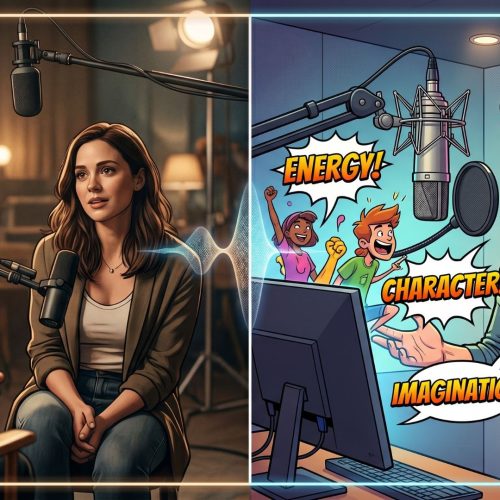
In the realm of modern storytelling, the human voice remains the most potent tool for emotional transmission. However, the technical and creative demands placed on a performer vary wildly depending on whether they are appearing on camera or behind a microphone. While both mediums require a deep understanding of character and subtext, the transition between live-action and animation is far from a simple change of wardrobe. It is a fundamental shift in how a performance is constructed, captured, and delivered to the audience.
The Physicality of the Frame
In live-action performance, an actor has a vast toolkit of non-verbal communication. A slight twitch of the eye, the slump of a shoulder, or a heavy sigh caught in a close-up can communicate volumes without a single word being spoken. The actor’s body is their primary instrument, and the voice is often just one component of a holistic physical presence.
Conversely, voice actors in animation work within a sensory vacuum. Because the audience cannot see the performer, every ounce of characterization must be poured into the vocal track. This often leads to a “larger than life” approach. If a character is surprised in a live-action film, a sharp intake of breath might suffice. In animation, that surprise must be colored with specific vocal textures—pitch, resonance, and breathiness—to ensure the emotion translates through the layers of hand-drawn or digital art.
The Chronology of Creation
One of the most jarring differences for performers moving between these worlds is the timeline of production. In live-action, the performance is the foundation. The cameras roll, the actors interact in real-time, and the edit is built around those captured moments. The physical environment—the lighting, the set, the other actors—provides immediate stimuli.
Animation flips this script. Typically, the voice is recorded first, long before the final character designs are even polished. The voice actor is performing in a booth, often isolated from their co-stars, reacting to a script and perhaps some rough storyboard sketches. In this scenario, the voice actor is actually the one leading the animators. The “acting” happens twice: first in the recording booth, and then at the animator’s desk, where the visual performance is meticulously timed to the nuances of the recorded audio.
According to deep-dive industry insights from The Hollywood Reporter, this “voice-first” workflow allows animators to use the specific mouth shapes (phonemes) and physical quirks of the actor to inform the character’s movement, creating a seamless marriage of sound and sight.
Technical Precision and the “Pop”
The technical environment of a recording studio demands a different kind of discipline than a film set. In live-action, microphones are often hidden or boomed from a distance, allowing the actor to move freely. In voice-over, the microphone is a microscopic lens. Every mouth click, stray breath, or inconsistent “plosive” (the popping sound of ‘P’s and ‘B’s) is magnified.
Voice performers must master “mic technique”—knowing when to lean in for an intimate whisper or back away for a shout—to maintain a consistent audio level without sacrificing the raw energy of the scene. Furthermore, they must maintain “vocal matches.” In a long-running animated series, an actor might have to recreate a specific pitch and rasp they established years prior, whereas a live-action actor’s natural aging is often written into the character’s journey.
The Collaborative Alchemy
While a live-action actor collaborates with a director and cinematographer on set, a voice actor’s primary partner is the sound engineer and the animation director. The process is highly iterative. A single line might be recorded fifty times with fifty different “reads”—varying the emphasis, the speed, and the “smile” behind the words.
Variety has frequently highlighted how modern animation has begun to bridge this gap through performance capture (mo-cap). In films like Avatar or Lord of the Rings, the distinction blurs. Here, the actor provides the voice, the facial expressions, and the body movements simultaneously, which are then mapped onto a digital “skin.” This hybrid medium requires the stamina of live-action theater and the vocal precision of traditional animation.
This meticulous attention to detail becomes even more complex when a project goes international. The nuance captured in the original booth must be translated and recreated by a whole new team of performers across different languages. This is a core reason why localization matters in global streaming platforms, as the emotional “soul” of the performance must remain intact even when the language changes. Variety has frequently highlighted how modern animation has begun to bridge this gap through performance capture (mo-cap). In films like Avatar or Lord of the Rings, the distinction blurs. Here, the actor provides the voice, the facial expressions, and the body movements simultaneously, which are then mapped onto a digital “skin.” This hybrid medium requires the stamina of live-action theater and the vocal precision of traditional animation.
Emotional Resonance: Why it Matters
Despite the technical differences, the end goal remains identical: empathy. Whether it is Meryl Streep on a rugged coastline or Tom Hanks voicing a plastic cowboy, the audience needs to believe the internal life of the character.
In animation, the voice actor must overcome the “Uncanny Valley” or the inherent flatness of a drawing by providing a “soul” through sound. They provide the heartbeat that makes the audience forget they are looking at pixels or ink. In live-action, the actor must often fight against the distractions of a massive film crew and green screens to find a moment of private, quiet truth.
Summary of Key Differences
| Feature | Live-Action Performance | Animation Voice Performance |
| Primary Tool | Full Body & Facial Expression | Vocal Texture, Pitch, & Pacing |
| Production Order | Visuals captured first/simultaneously | Audio usually recorded before animation |
| Co-star Interaction | Direct, physical interaction | Often recorded solo in a booth |
| Environment | Physical sets/locations | Sound-treated recording studio |
| Constraint | Physical reality and age | Limited only by vocal range |
Conclusion
The evolution of film and media continues to push these two disciplines closer together. As technology allows for more nuanced facial animation, the “big” performances of traditional voice acting are becoming more subtle, borrowing from the school of live-action realism. Simultaneously, live-action blockbusters are increasingly reliant on “voice-only” roles for CGI creatures.
Ultimately, the mastery of either craft requires an incredible amount of imagination. To act is to live truthfully under imaginary circumstances; to voice-act is to build that truth out of thin air, using nothing but the vibration of air and the resonance of the human spirit. Whether in front of a lens or a pop filter, the performer’s job is to ensure that when the character speaks, the world listens.