
The magic of cinema has always been its ability to transcend borders, but while a stunning visual needs no translation, dialogue is a different beast entirely. To bring a blockbuster from Hollywood to the streets of Seoul, or a gritty Spanish thriller to an audience in Chicago, filmmakers rely on the intricate, often invisible art of dubbing.
Far more than just replacing one language with another, dubbing—formally known as Automated Dialogue Replacement (ADR) or language localization—is a sophisticated blend of technical precision, linguistic adaptation, and raw acting. It is the reason a foreign film can feel like a local masterpiece.
1. The Script Adaptation: Finding the “Lip-Sync”
The process begins long before an actor enters a recording booth. A direct translation is rarely enough. If an English character says “Hello,” it takes a fraction of a second. The Spanish equivalent, “Hola,” matches well, but the German “Guten Tag” is significantly longer.
Translators and “adapters” work together to ensure the new dialogue matches the labial movements (lip-sync) of the original actors. This involves:
- Phonetic matching: Prioritizing words that start with similar consonants (like ‘P’, ‘B’, or ‘M’) which require the lips to close.
- Length management: Ensuring the sentence ends exactly when the actor on screen stops talking.
- Cultural Nuance: Swapping local idioms for equivalents that preserve the original intent without confusing the new audience.
2. The Casting Call for Voices
Dubbing is often called “acting in the shadows.” Studios don’t just look for voices that sound like the original; they look for voices that capture the emotional essence of the performance.
In many countries, such as Italy, France, and Germany, certain “voice doubles” become the permanent local persona for Hollywood stars. If you watch a Tom Hanks movie in Italy, chances are you are hearing the same Italian actor who has voiced him for decades. This creates a sense of continuity and trust with the audience.
3. The Technical Process: Inside the Booth
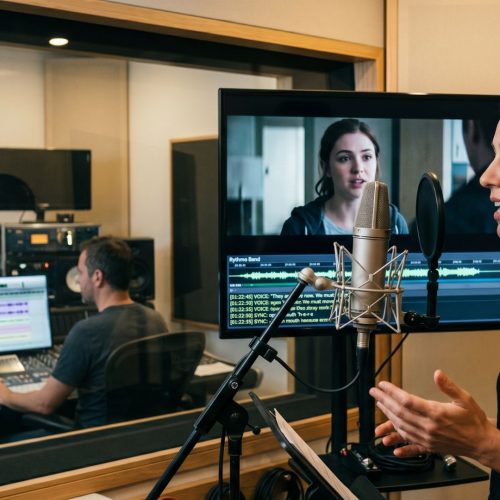
Once the script is “locked” and the talent is cast, the technical phase begins. This is where the marriage of art and engineering happens.
The Rhythm of the “Beep”
Actors usually record in a darkened studio, watching the original footage on a monitor. To help them time their lines, they use a system of visual or audio cues. A common method is the “three-beep” system: the actor hears three rhythmic tones and must begin their line exactly where the fourth “silent” beat would land.
Layering the Sound
In modern cinema, the original audio isn’t just one file; it’s a complex “M&E” track (Music and Effects). According to the technical standards highlighted by the Society of Motion Picture and Television Engineers (SMPTE), maintaining the integrity of the background ambiance while replacing the center-channel dialogue is crucial.
The dubbing engineers must ensure that the new voices don’t sound “flat” or like they were recorded in a sterile room. They use reverb and equalization to make the voice match the environment on screen—whether it’s a cavernous cathedral or a cramped car.
4. Cultural Localization vs. Translation
A major challenge in international cinema is how to handle humor and slang. A joke about American baseball might fall completely flat in Japan. In these instances, the dubbing director makes a “creative pivot.”
For example, when Disney localizes its films, they often rewrite entire songs or jokes to resonate with local folklore. This level of detail is what allows a film to feel “native” to its new territory. It is a testament to the global reach of the industry, a topic often explored in-depth by The Hollywood Reporter when analyzing international box office trends.
5. The Evolution: AI and the Future of Dubbing
We are currently entering a transformative era for international cinema. Traditional dubbing is expensive and time-consuming, often taking weeks or months for a single feature film.
Artificial Intelligence is now beginning to play a role through:
- Voice Cloning: Using AI to replicate the original actor’s voice in a different language, maintaining their specific timbre and grit.
- Neural Lip-Syncing: Using deepfake-style technology to actually alter the mouth movements of the actor on screen to match the new language’s phonemes.
While some purists argue this removes the “soul” of the voice actor’s performance, others see it as a way to democratize global content, allowing smaller indie films to reach worldwide audiences without the massive overhead of traditional dubbing houses.
6. Why Dubbing Prevails Over Subtitles
The debate between “Sub vs. Dub” is eternal. While subtitles preserve the original performance, dubbing offers a more immersive experience for many.
- Visual Continuity: Dubbing allows the viewer to focus on the cinematography and the actors’ eyes rather than reading text at the bottom of the screen.
- Accessibility: For children’s films or for audiences with visual impairments or lower literacy rates, dubbing is the only viable gateway to international stories.
- Emotional Impact: Hearing a character scream or whisper in one’s native tongue often carries a more visceral emotional weight.
Conclusion
Dubbing is a high-wire act of synchronization. It requires the translator’s wit, the actor’s passion, and the engineer’s precision. When done poorly, it can be a distraction; but when done well, it is invisible. It allows a story told in a small village in South Korea to break hearts in a cinema in Paris, proving that while our languages are different, the emotions we convey through film are universal.
As technology continues to bridge the gap, the “international” label on cinema may eventually disappear, leaving us with just one thing: great stories, heard by everyone.